Pancake Media: Digital Signage, Concierge, Visitation, and Why I Invested
Bjørn T. Nøstdahl
~10 min read
Some news from my side: I have invested in 20 percent of Pancake Media AS. The company builds three products for sports clubs, businesses and public organisations: digital signage, an interactive kiosk called Concierge, and a visitor management system called Visitation. Alongside them it offers consultancy, which is where my own experience now becomes available to customers. This article starts with the people behind the company, walks through the three products, explains what the consultancy covers, and ends with why I said yes.
The people
A company this size is its people, and this team is an unusual mix. What they have in common is that every one of them has stood in a sports hall or a lobby as a user long before they sold anything into one.
Finn Ivar Clausen is a serial founder, and Pancake Media is the latest in a line of companies he has started and built. He runs products, sales, installation and service, which in practice means he is the one who answers the phone when a club wants a screen, and the one who makes sure it is on the wall and working. Founders who have done it several times tend to know which problems are real, and Finn Ivar has that instinct.
Glenn Olstad is a familiar face from NRK, Norway's public broadcaster, and he brings that background to content production: film, visual communication and the material that goes on the screens. A screen is only as good as what is on it, and having someone who has spent a career making things worth watching is the difference between signage people read and signage people walk past.
Knut Henrik Spets played professional ice hockey for Lillehammer, Storhamar and Vålerenga in Norway, in the Swedish league, and for Norway at the World Championships. He knows what happens in an arena from the inside: what players, parents and clubs actually need from a scoreboard, a screen and a lobby, and what they will ignore. For a company whose first customers are sports clubs, that knowledge is worth more than any market report.
Rune Burkeland is a former football player and a partner at CK. He brings the commercial and partnership side, and the perspective of someone who has been on both sides of the line between sport and business, which is exactly the intersection Pancake Media lives in.
And then there is me, on the consultancy side, which gets its own chapter below. Five people, four very different routes into the same building, and a shared belief that sport and business have more to offer each other than either usually admits.
Digital Signage
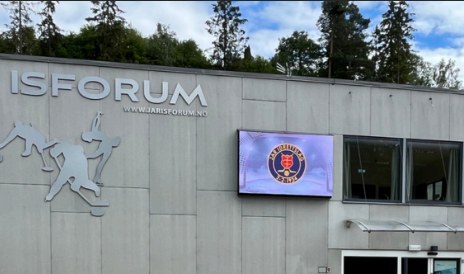
Information screens are where Pancake Media started, and they remain the most visible product. The company sells, installs and services both ordinary screens, measured in inches, and LED walls, measured in square metres. LED walls are built from panels assembled in cabinets, so they can be made in almost any shape and size, they are bright enough for lit halls and outdoor use, they last a long time, and a faulty panel can be replaced without replacing the wall. Two of the first installations are a screen showing the club collection for Jar idrettslag and a large facade screen on the outside of Jar Isforum.
The screens run Pancake Publy, the publishing system. Content is controlled from one place and you decide at any moment what is on the wall. Ready-made apps pull in YouTube, Facebook, Instagram, Google Calendar, weather and news, and custom layouts are built on top. Each screen stores its content locally and only synchronises what is new, so it keeps playing through a network outage. The solution is licence-based, arrives pre-installed, and needs nothing but an internet connection to start.
For sports venues there is Pancake Scoreboard, a live results service. It uses a Bodet scorepad together with a score app on phone and watch, works for every kind of sport, and is approved for both grassroots and elite competition. In the breaks the same screens show advertising and entertainment, which is how a club turns a scoreboard into income. The results board in Jar Isforum is the reference installation.
Concierge
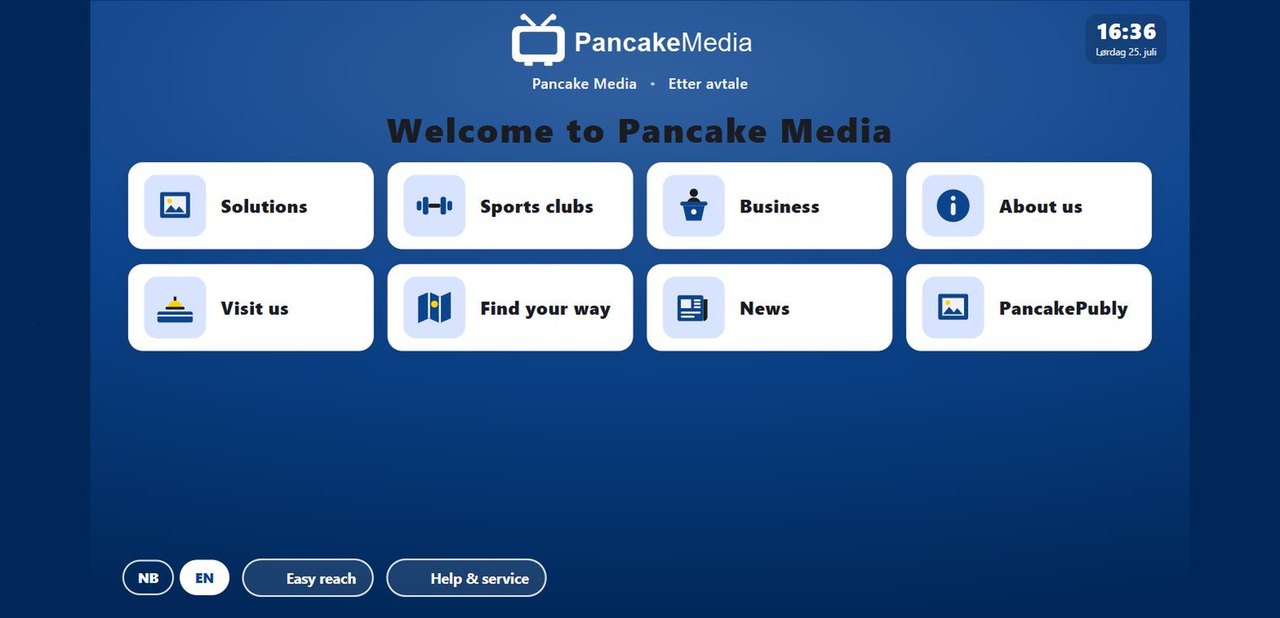
Concierge is an interactive kiosk for the entrance of a building: a touchscreen that greets visitors, shows them where to go, and answers the questions a reception desk hears all day. It is built for retail stores and showrooms, offices and head offices, sports halls and clubs, and public buildings and clinics.
What it does:
- Department pages with headings, intro text and cards, nested as deeply as the building needs.
- Wayfinding as numbered steps to a door or a floor, or as a route shown on the customer's own map.
- Offers and news cards with a location and a "show on map" button, and coupons with their own QR code and validity date.
- Norwegian and English, switched with one button in the footer.
- Easy reach, which moves the whole screen down so seated and wheelchair users can reach everything, plus a button to call a member of staff.
- An attract screen that returns when the kiosk is idle.
It runs in a browser on ordinary screens and tablets, in landscape or portrait. A new kiosk is set up by choosing a logo and one colour, after which the platform does the rest, and the company says a kiosk is typically live within a day. Content is edited once in the Pancake App and appears on every kiosk at the same time. A sports hall can show what is on this week and the route to the right hall in two languages for visiting teams; a head office can spare its receptionist the same four questions every morning.
Visitation
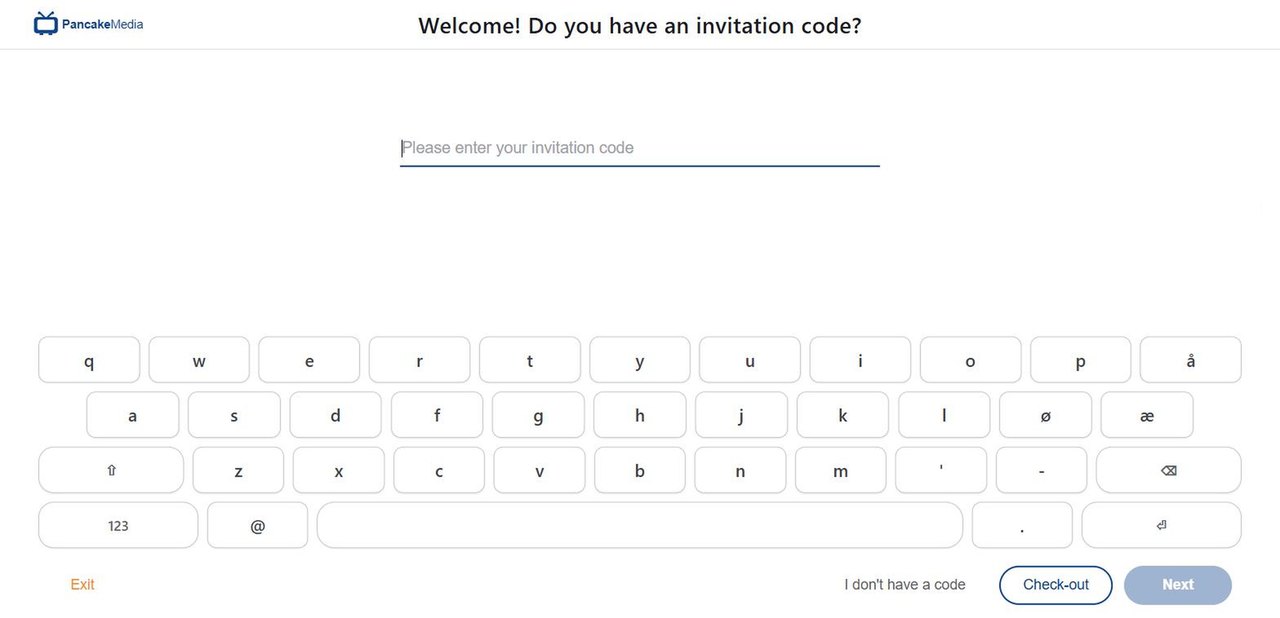
Visitation is self-service visitor management: guests check themselves in on a tablet in the lobby, so a reception appears staffed without being staffed.
The visitor flow:
- Check-in. Invited guests enter their invitation code; everyone else taps "I don't have a code" and still gets in.
- Host. The guest searches for the person they are visiting and enters their name and contact details.
- Verification. Photo and ID scanning can be switched on where it is needed. If a scan fails, the number is typed by hand.
- Company. The guest picks their company from a registry or adds it. Returning visitors and regular contractors do not type it again.
- Purpose and agreement. The guest states the purpose of the visit and signs the visitor agreement on screen. Nobody proceeds without signing, so the NDA is handled before the meeting instead of chased afterwards.
Every entry lands in the Pancake App, where staff see who is expected today, who is inside right now, and the full history with company, host, purpose, check-in and check-out times and the signed agreement. If the fire alarm goes off, the list of who is in the building is one phone call away. It runs in a browser on ordinary tablets and panels with an on-screen keyboard, and each terminal is registered with a location and a zone. Offices with an NDA to sign, facilities with regular contractors, shared buildings where every tenant has its own hosts, and studios and labs where visitors sign at the door are the typical installations.
One platform
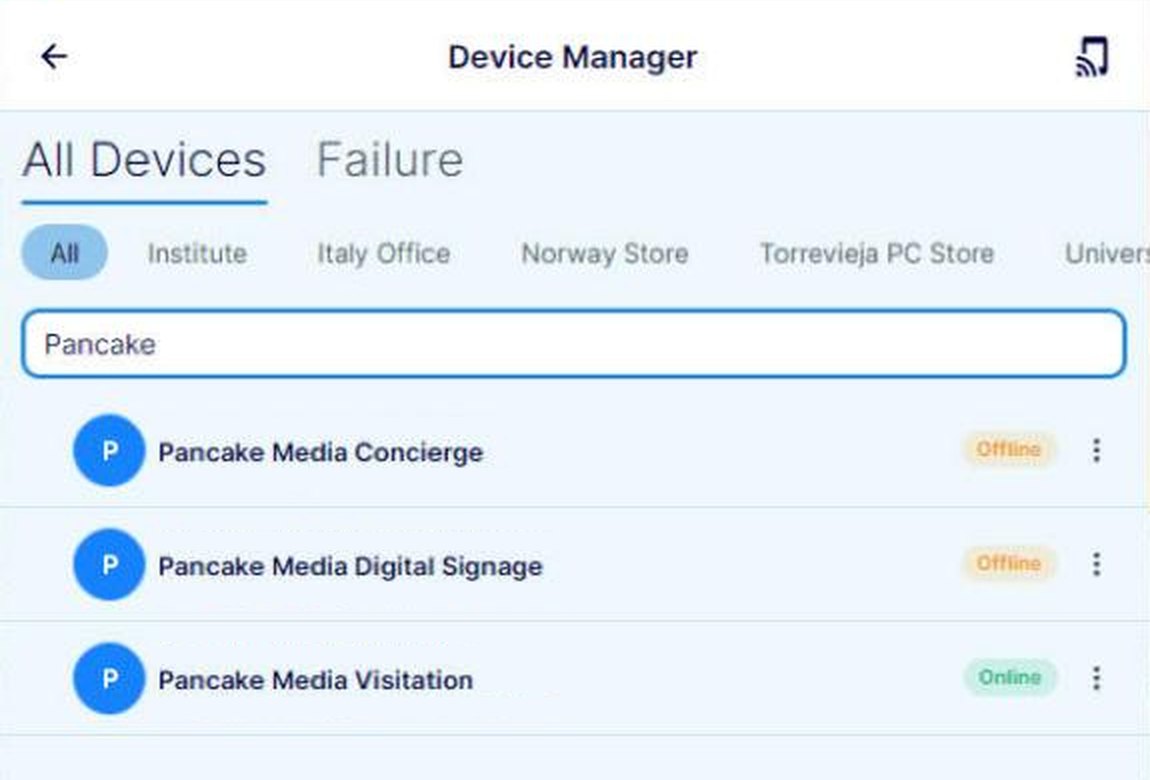
What makes the three products more than a catalogue is that they share one platform, hosted on Microsoft Azure. Screens, kiosks and check-in terminals are all registered in the same device manager in the Pancake App, where each device shows its status and picks up the customer's logo and colour. Signage screens point visitors to the check-in terminal, the kiosk guides them once they are inside, and a news item written once appears everywhere.
Consultancy
This chapter is the one I most want readers to notice. Pancake Media also offers consulting services, and through the company my experience is now available to customers as a consultant. The pitch on the site is simple: do you need more hands, or a fresh pair of eyes, on a digital project? You can bring in one competence or several working together, and the work is done closely with your own team.
The services fall into four groups.
Design and Figma. Clickable prototypes to test an idea before anything is built, design systems and component libraries, and handoff files that developers can build from. UX and UI for web and apps, design for information screens and kiosks, and visual profile and content.
Software development and integrations. Web solutions and apps, cloud solutions on Microsoft Azure, and operations, maintenance and further development after launch. Integrations cover APIs and data flow between systems, automation of manual routines, and connections to the business and professional systems you already run, whether that is a membership register, a booking system, access control or a CRM.
Product and project management. Product strategy and roadmaps, prioritisation and backlog, and user insight with measurement of what actually changed. On the project side: planning, progress and risk tracking, coordination of teams and suppliers, and regular reporting. This is the part of my working life I have written about most on this blog, from Scrum certification to the Microsoft LEAP architecture series.
AI, done carefully. Three concrete offerings. Agentic AI, where AI agents carry out tasks in your systems through Model Context Protocol servers, with testing and evaluation before anything is rolled out. AI-driven automation that reads, classifies and summarises email, documents and inquiries, routes tasks and updates CRM or case-handling tools. And multimodal customer support: assistants for Microsoft Teams and other channels that handle text, voice, images and documents, answer from a knowledge base, open or update support cases, and hand the conversation history to a human when a human is needed.
Readers of this blog will recognise the themes: connected devices in the field, cloud platforms, security, and the DevSecOps habits that keep all of it running. What is new is that you can now hire that experience for your own project, not just read about it. The starting point is a no-obligation chat: write to bjorn.nostdahl@pancakemedia.no, or reach the company at sales@pancakemedia.no.
Why I invested
The name was coined by the founders on the way to a training session at Jar Ishall, long before I was involved: the screens are flat as pancakes, somebody said, and it stuck. I like the story because the company has kept that practical attitude as it has grown. Three things convinced me.
- It is a platform, not a box. A device manager, a shared profile, content written once, hosted in Azure. That is a software company that happens to install screens, which is a far better business than a screen company that happens to have software.
- The customers are sports clubs and the people who run buildings. Norwegian clubs run on volunteers, and every krone a screen earns is a krone the parents do not have to raise. Offices, clinics and sports halls share the same lobby problems, and a kiosk and a check-in terminal solve them without hiring anyone.
- The people. A serial founder, a broadcaster, a professional hockey player and a footballer turned business partner is not a team you assemble by accident. They have stood in cold arenas and busy lobbies and know what works on a wall, which is not the same as what works in a demo.
The company also supplies charging stations with card payment and unattended smart fridges, which sports halls like for the extra income. Good products, but the platform and the consultancy are why I am here.
Questions for you
- If you run or volunteer for a sports club: what would you put on a screen in the hall, and what would a kiosk at the entrance need to answer?
- Office and facility managers: does a self-service check-in with a signed agreement solve a problem you have, or create one?
- Which of the consultancy areas would you actually use: design, development, integrations, project management, or AI? I am curious where the demand really is.
Write to me at bjorn.nostdahl@nostdahl.com for the blog, or at bjorn.nostdahl@pancakemedia.no if you want to talk about a project.